
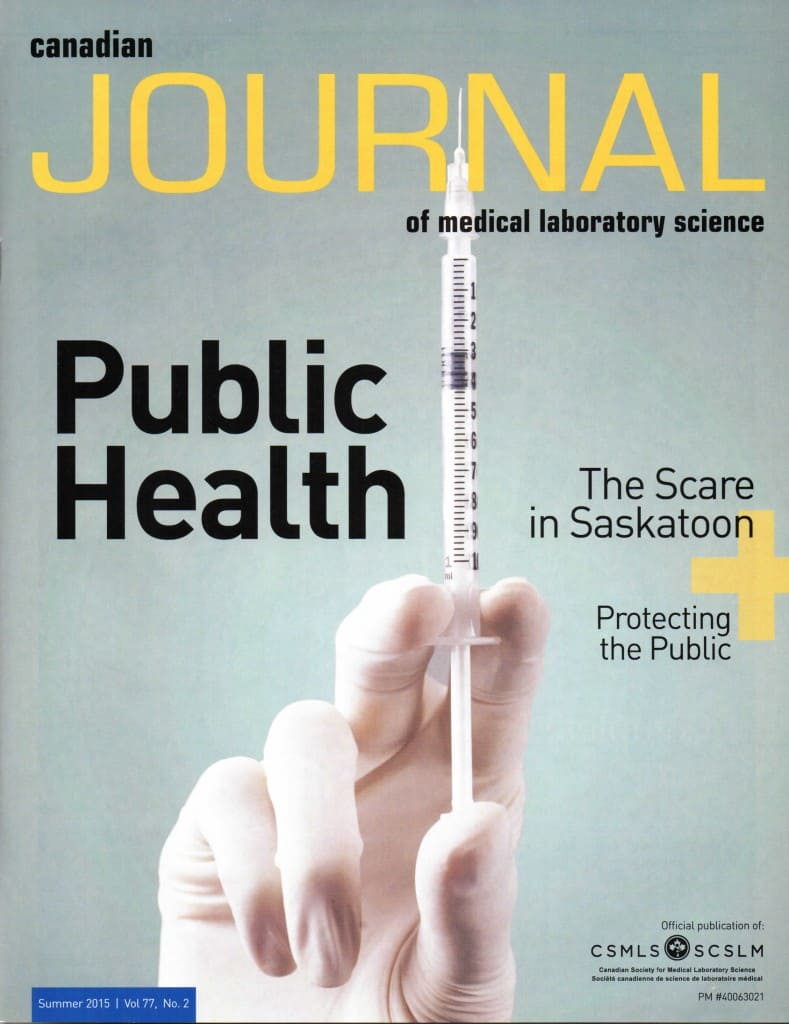
You have probably heard about the Ebola epidemic that began in West Africa in early 2014 and continues today. But I bet you have never heard about an Ebola scare in Saskatoon that happened only a few days after the outbreak began in March 2014.
For this story for The Canadian Journal of Medical Laboratory Science, I spoke to Dr. Joseph Blondeau, Acting Department Head for Pathology and Laboratory Medicine with Saskatoon Health Region and Mary-Louise Graham, Director for the Office of Biosafety and Biocontainment Operations, Centre for Biosecurity at the Public Health Agency of Canada.
It was an extremely tense 48 hours. ~Dr. Joseph Blondeau
A patient with an unknown viral hemorrhagic fever arrived at a Saskatoon hospital, late one Sunday night. The patient’s condition was deteriorating rapidly — he had a diffuse rash, fever and was bleeding from the eyes. His medical history was difficult to obtain, but one thing stood out — he had recently returned from Liberia, the Ebola hot zone, within the 2-21 day incubation period for the disease.
To further complicate things, this was happening in Saskatoon, Saskatchewan, where there was no authorized courier that could transport blood specimens to the only Containment Level 4 lab in Canada, located in Winnipeg, Manitoba, a 10-hour drive away.
As of July 15, 2015, there have been 27,688 reported cases and more than 11,279 deaths, according to the CDC.
Click on the image below to read the whole story and find out what happened.
 In a new book, The Weight of the Nation: Surprising Lessons About Diets, Food, and Fat, the authors conclude that the obesity crisis is completely preventable: “The only thing you need is the truth. The truth about why we’re fat, and how we can fix it.” The authors don’t mince words as they outline the plain, hard facts about how obesity became an epidemic and what it will take to win the war, no matter how many times people have tried to lose weight before. The book is a companion to the